SVG vs WebP vs AVIF: Browser Decoding, VRAM & LCP Benchmarks
Compare vector DOM rasterization against WebP and AVIF bitmap decoding across transfer bytes, GPU texture memory, and Core Web Vitals.
Clean Vector Geometry, Accessible Icon Systems & Zero-CLS Dividers
Clean Illustrator and Figma SVG exports, optimize path precision, build accessible icon sprites, and prevent sub-pixel divider seams.
Test parameters interactively and export production-ready CC0 code directly in your browser.
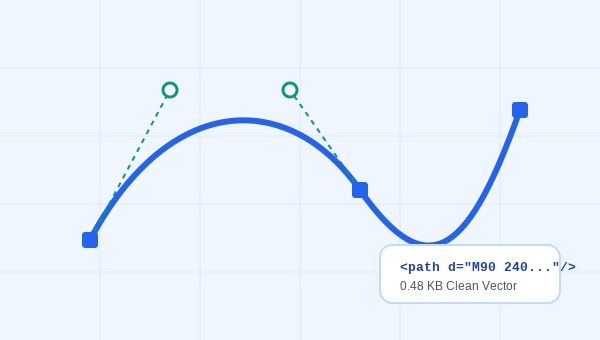
Rounding exported 6-decimal coordinates to 1 or 2 decimals cuts path string bytes by 30% to 45% with zero visible shift on 4K Retina screens.
Flattening deeply nested <g> groups and reusing symbols lowers DOM node counts and keeps Interaction to Next Paint (INP) fast.
Untrusted SVGs can execute scripts via inline event handlers or foreignObject tags. Production pipelines always sanitize XML trees.
Compare vector DOM rasterization against WebP and AVIF bitmap decoding across transfer bytes, GPU texture memory, and Core Web Vitals.
Configure SVGO v3/v4 safely without breaking viewBox scaling, ARIA hooks, or CSS animations—and shrink vector exports by 45% to 70%.
Architect scalable icon delivery for modern web apps: benchmark external <symbol> sprites, CSS mask-image icons, and inline Astro/React components.
Eliminate clipped strokes, distorted aspect ratios, and responsive wave stretch bugs with a complete guide to SVG coordinate math.
Build GPU-friendly procedural noise textures, metaball gooey transitions, and color-matrix duotone filters using native SVG <filter> pipelines.
Ensure inline and external SVG icons, charts, and interactive buttons meet WCAG 2.2 accessibility standards across VoiceOver, NVDA, and JAWS.
Understand why raw user-uploaded SVG files act as executable HTML documents—and harden uploads with DOMPurify, CSP headers, and server rules.